The Buzz in the Woods: Restoring Forest Habitat for Native Bees
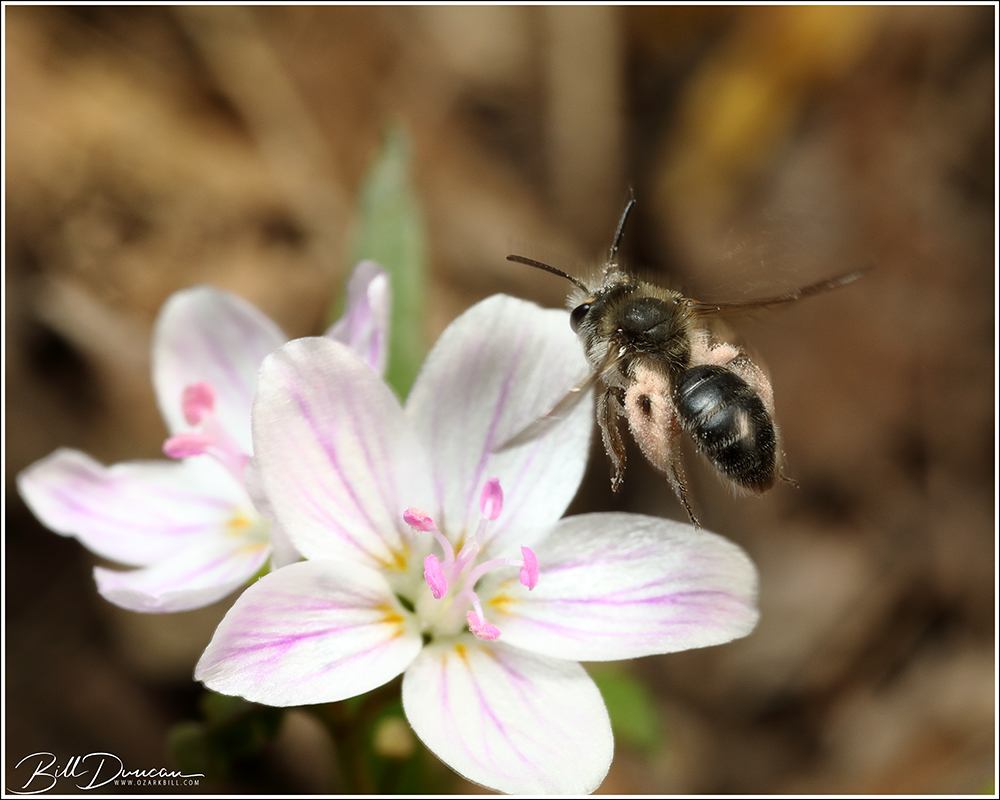
Here’s a little-known fact: of the roughly 450 bee species in the Northeast, about a third will only forage and nest in forests, and another third use forests for at least part of their lives. When we picture pollinators, we tend to picture meadows and gardens. It turns out the woods are buzzing too.
Winnakee is planning a 40-acre forest restoration project at Robert’s Refuge to bring back the habitat these bees need, and we are grateful to have advisor Kass Urban-Mead of the Xerces Society helping guide the planning. This past spring, Kass and Lacey Smith of Pollinator Partnership were the featured speakers at our landowner webinar on woodland pollinators. The project at Robert’s Refuge will be a hands-on demonstration of many of the techniques they recommended for enhancing pollinator habitat in the forest.
“The goal of the project is to increase the biodiversity of woodland pollinator species and to serve as an example that landowners can explore for their own lands,” said Jen Adams, Winnakee’s Senior Conservation Biologist and Director of Parks and Ecological Preserves.
Groundwork for the project is already underway. Winnakee staff have completed baseline monitoring that recorded the abundance of bees present, when they show up, and which plants they visit. Those data are now shaping plans for forest management that will attract a greater diversity of species.


What forest bees need
Many forest bees depend on the early spring trees, shrubs, and wildflowers that bloom before the canopy leafs out and shades the forest floor. At Robert’s Refuge, the canopy is extremely dense. Part of the preserve was once a red pine plantation, and it has since filled in with trees of the same age, so little sunlight reaches the ground in early spring. Deer browsing and invasive plants have taken a toll on the understory as well, crowding out many early spring wildflowers.
For nesting, many species use dead or decaying hardwood, while others cluster in the soil. The deadwood at Robert’s Refuge comes mainly from declining red pine, which bees tend to avoid, and invasive jumping worms are changing the soil that ground-nesting bees rely on.
The plan to attract more woodland pollinators
Winnakee’s forest restoration plan will remove ailing non-native red pine and invasive trees and shrubs, thin poor-quality trees to let in light, and favor trees that offer early nectar and pollen. Native shrubs and tree seedlings will be planted in new canopy gaps, with deer fencing to protect them while they get established. Standing dead hardwoods and logs will be left in place as nesting sites for solitary bees as well as birds and bats.

with Todd Waldron and Jen Adams of Winnakee.
A living classroom
The project also includes four 2.5-acre demonstration plots focused on oak and hickory resilience. Winnakee staff recently walked the preserve with forester —who will guide the silviculture implementation—to map out where the plots will go in 2027. One plot will be left alone as a comparison, and the other three will show different forest management techniques, from light thinning around healthy oaks and hickories to small canopy openings.
Much of Dutchess County’s forest is privately owned and unmanaged, so the demonstration plots will give landowners and partners a chance to see what these techniques look like on the ground and how the forest responds over time.
DIG DEEPER:
WATCH OUR LANDOWNER WEBINAR ON WOODLAND POLLINATORS
Featured speakers Kass Urban-Mead of Xerces Society, Lacy Smith of Pollinator Partnership, Stacey Kazkos of the NY Forest Owners Association and Uri Perrin and Todd Waldron of Winnakee Land Trust.